The Third Revolution Xi Jinping and the New Chinese State Economy Review
In The Third Revolution: Xi Jinping and the New Chinese State , Elizabeth Economy offers an exhaustive study of Xi Jinping's first five-twelvemonth term as the leader of Prc. This panoramic evaluation is as thorough as information technology is balanced, writes Vasilis Trigkas ,and should be cadre reading for anyone looking to empathise how Eleven'south revolution is transforming Communist china.
The 3rd Revolution: Xi Jinping and the New Chinese State . Elizabeth Economy. Oxford Academy Press. 2018.
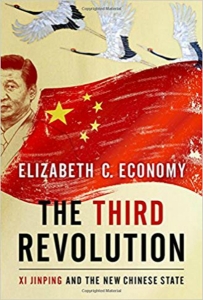 Find this book (affiliate link):
Economists and pundits alike have shed much ink to discuss People's republic of china'southward 40th anniversary of opening up and reform, yet information technology is a sweeping neo-Leninist political revolution with Chinese characteristics that is remaking the Middle Kingdom: Xi Jinping's revolution. This is the cadre idea in The Third Revolution, Elizabeth Economy'southward exhaustive study of 11's beginning 5-twelvemonth term equally the revolutionary caput of the world's most populous nation and America's prime number geopolitical challenger.
Not many authors would be equally qualified as Economy to write about a neo-Leninist revolution within a clandestine one-party polity. A sovietologist by grooming, Economy turned to China in the 1990s when the Soviet Union was no more and Cold War experts faced a difficult job market. Equally a C.V. Starr senior beau and managing director for Asian studies at the Quango on Strange Relations – a networked powerhouse – Economy has the reward of cordial exchanges with a vast network of officials, scholars, dissidents and business executives who provide key insights on Mainland china in the epoch of Xi.
In act one Xi enters the stage as Economy panoramically guides readers through the revolution. In half a decade Eleven has been a prolific ideologue: the two undeniables, the four comprehensives, the twelve ideas on cadre socialist values and the three confidences are all his ideological catchphrases in an endeavour to solidify his narrative near the past, tighten his grip on the present and make certain that People's republic of china'south future volition follow the path he envisions with the Communist Party of Communist china (CPC) always in charge as the nation rejuvenates:
Eleven seeks a uniquely Chinese model that he believes will deliver the Chinese dream and perhaps become a standard bearer for other countries disenchanted with the American and European model of liberal democracy (12).
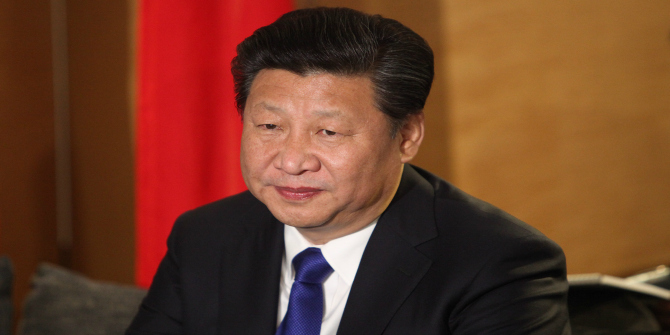 Prototype Credit: Crop of 'China State Visit' by Strange, Commonwealth & Development Office licensed under CC Past 2.0
The outset arena where Eleven's policies take institute solid application is the ChinaNet – a vast firewalled internet nether the decisive informational control of the CPC. During its early period, the bully firewall was more of a defensive line to insulate China from 'Jasmine Revolutions'; now information technology has allowed the CPC to foster a massive net marketplace (by blocking US Silicon Valley companies and and so cloning them) and monopolise the narrative about Chinese history. Still, perhaps almost importantly, the success of Communist china's domestic internet economy has empowered Beijing with the normative authority to challenge the open internet globally by proclaiming the need for 'Internet sovereignty'.
Another arena of Eleven's revolutionary exercise has been the 'Socialist market'. For Eleven the CPC must dominion supreme, and Economy notes that while the Tertiary Plenum in 2013 declared that the marketplace volition take a 'decisive office' in the Chinese economy, in practise 'monopolies that had been broken during the age of Zhu Rongji have now reconstituted themselves' (104). The visible arm of the state has expanded, yet China's meteoric success in the internet economy could by and large be attributed to its private internet corporations which have tapped into a 'Chinese middle class that is wired, gear up to buy and large on convenience' (121). Economy frames Jack Ma, the founder of Ali Baba who recently declared his long-time party membership, as a paradigmatic entrepreneur and rightfully submits that for Chinese leaders, innovation is seen equally key for Red china's economic future (123).
At a moment when pundits have sensationalised Mainland china's rising innovation capacity, Economic system'south assay on China'south political economic system enlightens: China, Economy asserts, innovates, only it rarely, if at all, invents. China is a champion of incremental innovation, not disruptive invention. This is more of an outcome of cost minimisation and massive (and often wasteful) industrial subsidies, BYD, the battery and automobile manufacturer, being a revealing example. With unresolved bug in attracting human capital and an environment which does not allow ideas to catamenia freely, Cathay's innovation ecosystem is problematic and Eleven's revolution seems to ignore the 'structural reforms that would enable Prc to lead in basic inquiry and develop breakthrough technologies' (150).
No study about Xi and China could be complete without a thorough evaluation of the Belt and Road Initiative (BRI) – Xi's pivotal foreign policy initiative to 'make all roads lead to Beijing' (190). Echoing Pang Zhongying, Economy submits that China'southward endeavor to expand its global economic outreach reflects a mod equivalent of huairou – 'pacifying and winning the hearts of foreigners through tributary trade' (222). Every bit the The states has faltered in its global developmental strategy, many countries celebrate China for its power to 'place and address the developmental needs of other countries' (222). Thus, the BRI could in the long term get a normative competitor to the Western developmental model.
Economic system concludes with a series of recommendations on how the US should respond to Xi'due south global strategy. She believes that the US must observe Prc'south domestic agenda and bargain proactively instead of just reacting to Communist china's regional and global initiatives. In this sense, the 'engage and hedge' strategy that the Us has followed since its mail service-Tiananmen interaction with China remains relevant as it 'allows the relationship to be oriented in a positive trajectory but as well protects the United states in example of malign Chinese intentions' (235). Economy'due south operational advice to United states of america policymakers is not to short China only to long information technology and therefore work closely with allies, invest more than in domestic R&D, protect critical The states assets and approach the BRI every bit an opportunity too equally a challenge. Economic system rightfully asserts that the key challenge for the U.s. will be how to deal with Mainland china's 'wherewithal to accept suboptimal economic and efficiency outcomes generated by non-market practices in the nearly-term to endeavor to ensure market say-so in the long-term' (236).
Economy's treatise is equally thorough every bit it is balanced. She approaches China through the lens of an skilful-scholar and not an ideologue, yet in many instances she evaluates Mainland china's polity as prima facie restrictive for China'due south global leadership. She even asserts that Trump's debacles will not suffice to brand China a global leader (229). Nature, yet, abhors vacuums. With America retrenching, countries may bandwagon with China – the way the Philippines and particularly Pakistan accept bought Xi'southward calls needs to be explored. As Xi himself has declared, with recent events (i.e. the rise of populism in the Westward), the time of strategic opportunity for Prc has expanded. Thus, with America falling from within due to its unprecedented political predicament, China with all the limitations of its authoritarian Leninist system could oversupply out the United states from the Asia-Pacific. Information technology is therefore the wild bill of fare of politics within China and the United states of america that volition be the cardinal determinant of how the ii behemoths will perform in the years alee. The United states of america may exist a 'financial crisis or a state of war of choice abroad' from passing the global leadership to China. Similarly, Xi's revolution could slow down Communist china'due south economic evolution or even lead to domestic unrest.
Economy is extremely well read, citing a plethora of primary sources and discussions with experts. Notwithstanding her opus would have mayhap been more complete had she elaborated on the ideas of Xi's ideological allies in the clandestine corridors of power. For instance, the contribution of senior apparatchiks like Wang Huning and Wang Qishan and how their ideas incubate within the structure of the CPC – an analysis that Richard MacGregor (writer of The Political party: The Hush-hush World of China'south Communist Dominionrs) had washed exceptionally well for the period until Hu Jintao.
To exist sure, reading Economic system's panoramic evaluation of 11's first five-year term, one affair is certain: the long-held The states conventionalities that China's polity would morph into the image of America's has failed. For students of politics, diplomats, economists or all those who seek to understand how Xi's revolution is transforming Mainland china and the impact that a more assertive neo-Leninist behemoth will have on the global order, Economy's book is core curriculum.
Annotation: This review gives the views of the author, and not the position of the LSE Review of Books blog, or of the London School of Economics and Political Science. The LSE RB weblog may receive a pocket-size commission if you choose to make a purchase through the higher up Amazon affiliate link. This is entirely contained of the coverage of the book on LSE Review of Books.

barryanguareany1983.blogspot.com
Source: https://blogs.lse.ac.uk/lsereviewofbooks/2019/01/15/book-review-the-third-revolution-xi-jinping-and-the-new-chinese-state-by-elizabeth-economy/
0 Response to "The Third Revolution Xi Jinping and the New Chinese State Economy Review"
Post a Comment